Sunday, 12 June 2016

And now for something completely different! - Part 1


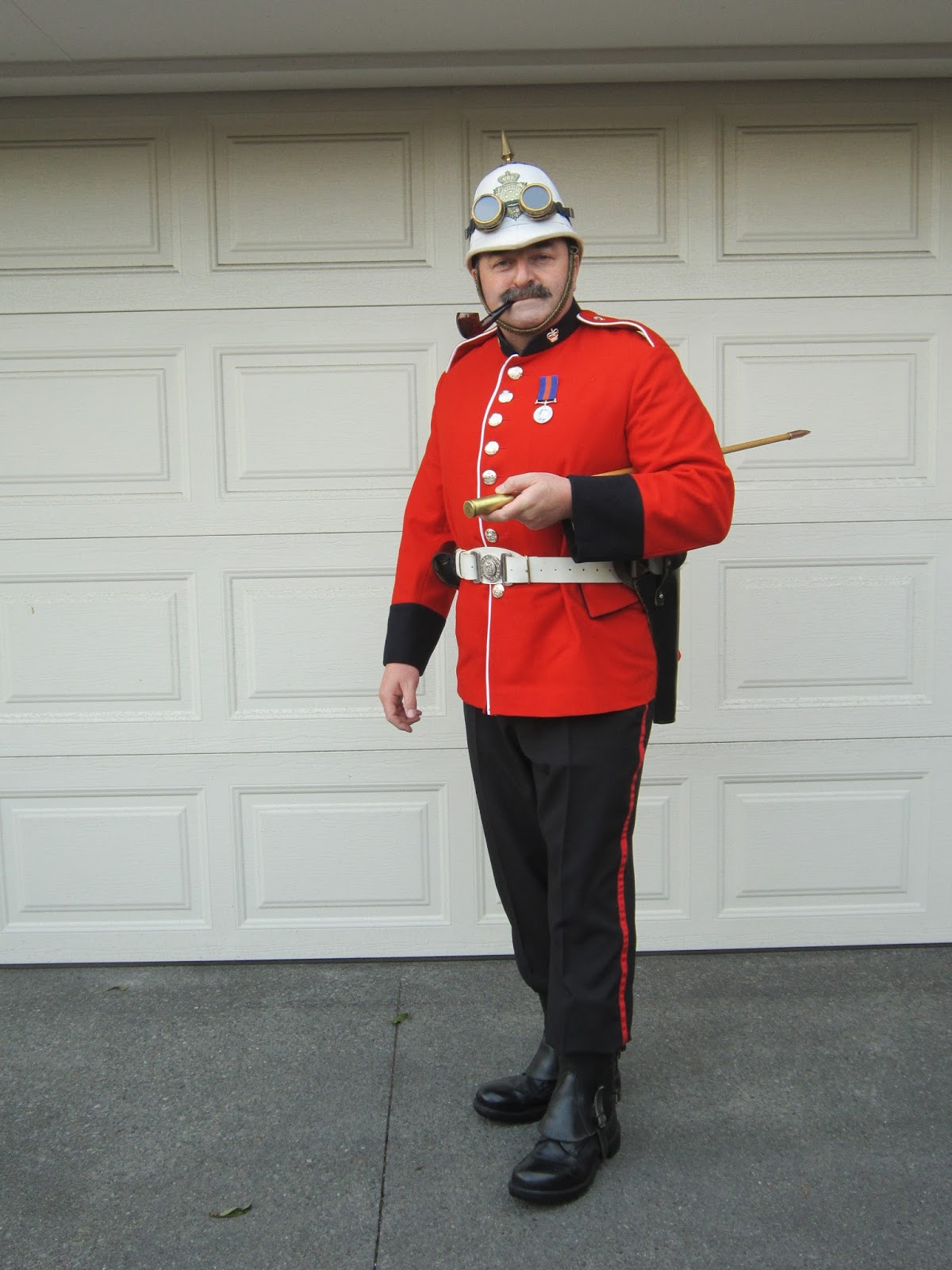
Turning 50 can make people do some strange and unusual things. When I reached a half century earlier this year I promised myself, that instead of just celebrating on my birthday, that I would make it a year of celebration by doing out-of-the-ordinary things. To this end I committed myself to attending the annual Queen's Birthday Weekend Steampunk Festival in Oamaru. Fellow Southern Strategist, Gavin Bowden (a.k.a Ogilvie VC in wargaming blogging circles), had taken part in this event on several occasions and convinced me that we could have a great weekend at the event dressed as Victorian era officers while also taking in the military sites of interest in Otago . To be honest, at the time I knew nothing about Steampunk and was only interested in the historical side of the trip. For the multitudes of those who know nothing of Steampunk, it's kind of like living history Victorian Science Fiction....inspired by the writings of Jules Verne, H.G. Wells, Sir Arthur Conan-Doyle and all those other Edwardian types who never lost their childhood imaginations.

I already had a collection of New Zealand militaria items that I could use, which included a white Foreign Service helmet sporting an original NZ Volunteers helmet plate and spike from the 1890s (purchased way back in my youth when I had no mortgage, wife or kids). What I lacked was a red tunic that fitted me. I had acquired a NZ Army Band tunic about 15 years ago, but for some strange reason it appeared to have shrunk over that time. Gavin came to the rescue when he discovered two large fitting Chelsea Pensioner coats at a local army surplus store. So, a few hundred dollars later and with some alterations from Jane, our very talented regimental seamstress, we were able to achieve the look we wanted.

One aspect of Steampunk is that you are encouraged to create a character to go along with the costume. Gavin had already established himself as Captain Reginald Ogilvie VC (with associated blog). With the Victorian theme in mind I came up with Major Septimus Sherlock-Brown of the New Munster Steam Fusiliers, late of the Kawatiri Field Force and mentioned in dispatches for lack of action in the Upper Buller Gorge. I got the name Septimus from a character from a Sharpe movie, while the double-barrel surname came from my maternal grandparents family names. I suggested to Gavin that we use 'New Munster' as a regimental name as this was the original name given to the South Island of New Zealand, while he came up with 'Steam Fusiliers'. Kawatiri is the Maori name for the Buller district where I originally hail from,while the use of the Buller Gorge added a hint of North West Frontier-type action celebrated in British Army history.
Major Septimus Sherlock-Brown, New Munster Steam Fusiliers, in parade dress. The only steampunk item is the goggles on the helmet.
Walking out dress and more suitable for visiting local hostelries. The swagger stick is adorned with a 50 mm shell and bullet. I even ignored the protests from my wife to re-grow my police-issue moustache to ensure the period look.  

             
 The weekend began with a 4.5 hour drive south to Dunedin to visit the fully restored gun emplacement at Taiaroa Head. Built in the 1880s at the height of the Russian invasion scare, the crowning jewel in the defensive position at the entrance to the Otago harbour mouth is the 6 inch breech-loading Armstrong disappearing gun, concealed within a earth parapet on an old Maori pa site on a hill. Cutting edge technology at the time it was installed in 1889, the gun was able to fire and disappear back into the gun pit below the surface so that the enemy ships had difficulty in destroying it. The gun had a range of 5 miles and a rate of fire of 1 round per minute. The barrel weighs 5 tonne and has a length of 17 feet 6 inches. The gun was raised through a pumped water and air ram system. On firing, the ram system was re-compressed as the gun recoiled into the gun pit for reloading. Advances in technology made the gun virtually obsolete by 1912 but it was still in operation until after the Second World War. It had a crew of 10 personnel and was fed from an ammunition magazine bunker below the gun. A very impressive piece of kit and well worth a visit if you find yourself in Dunedin with a couple of hours to spare.          

A model of the 6 inch Armstrong Breech-loading Disappearing Gun at Fort Taiaroa, Dunedin. 

The fully restored gun mounted below the top of the headland on the Otago Peninsula at the mouth of the Otago  harbour.

Note the measurements around the wall to assist the gunners in sighting the gun and the holes in the wall to allow the breech to be loaded.


The Mess diner of the New Munster Steam Fusiliers at the Criterion Hotel in the old Victorian quarter of Oamaru. We had booked a private room with a fire and rolled leather couches, which just added to the Victorian feel of the event. Of course, the evening was finished with rounds of Port and pipe smoking.    


Sherlock-Brown and Ogilvie VC outside the Criterion Hotel accompanied by Peter, dressed as the under-cover intelligence officer of the regiment.
Sherlock-Brown and Ogilvie sampling the local ale on the first night of our expedition to Oamaru. Hardly a hint of Steampunk-like dress on this occasion.

Part 2 to follow later.

Saturday, 23 April 2016

Making woodland terrain pieces


Inspired by some terrain pieces made by local gamers here in Christchurch, I decided to have a crack at improving on the woodland terrain pieces I made earlier in the year. My first go at doing this involved using Woodland Scenics trees purchased from a local model shop. These turned out ok, but I ended up having to use super glue to permanently attach the foliage. One of the other Southern Strategists (Geoff Martin) suggested a cheaper and less messy option which involved buying bulk bags of ready-made trees from our local Christmas shop. These trees came in various sizes and were perfect for what I had in mind.
As you can see, I cut out three 6 mm mdf pieces and glued on the ready-made trees and pieces of bark from our garden to represent rocks. 

Geoff and I had previously dipped the trees in watered-down PVA glue and sprinkled fine flock over them to get a more realistic look.

Using a variety of sizes on each stand also gives a more realistic look. At this point I applied filler around the base of the trees.


The next step was to add sand to the bases to provide texture to the ground.

This was followed by a base coat of dark brown 'tester pot' paint which cost only $5 NZ.

I then dry brushed the bases. At this stage I gave the pieces of bark a dark, then light coats of grey paint to give the rock affect. 

Finally I used a brush to apply PVA glue over the bases, followed by sprinkling hobby grass to add realism. Note that I left some areas exposed. 


I also added some  rushes and flower foliage to add a little extra to the terrain.

This proved a cheap and easy way to make versatile terrain for my gaming table. The only problem is that other gamers in the city had the same idea and bought up the last stock the shop had of the trees. Never mind, I'll be making more of these once they have more in stock...I just hope I don't have to wait until next Christmas!


Until next time.    
     

Tuesday, 22 March 2016

AWI 28mm British Legion Infantry

Tarleton's British Legion of the American War of Independence has always been tagged with notoriety, primarily for actions in the battle of Waxhaws in the southern campaign. It was here that the Legion, and Tarleton himself, were criticized for slaughtering rebel soldiers after they had surrendered. The villainous British Loyalist cavalry officer in the movie The Patriot  (2000), superbly played by Jason Isaacs, was loosely based on Tarleton and I suspect this movie has reinforced the myth surrounding Tarleton and his troops.

Those interested in a more balanced view of the topic should  read Brutal Virtue: The Myth and Reality of Banastre Tarleton (2002) by American, Anthony J. Scotti Jnr.

I've had the mounted corps of the Legion painted up for a number of years and have only recently painted the Legion infantry. Information regarding the infantry uniform is minimal. I decided to base my troops on information found in records in the National Archives at Kew which have the troops wearing white trousers and waistcoats, along with light infantry caps. It's generally accepted that they wore green coats, in keeping with loyalist light infantry units, although some historians argue there is evidence to suggest they may have worn red coats at the battle of Cowpens (where the infantry element of the Legion was destroyed).    


I've used Front Rank British Light Infantry figures to depict my Legion infantry. However, I removed the feather tufts from the caps (except for the officer) to give a more common look. I used Vallejo 'Black Green' for the base of the coat, then dry brushed them with 'Flat Green.'


I also decided to add white shoulder lace, as opposed to black shoulder lace that I've seen others use on their Legion infantry. I think this has worked in providing a nice contrast to the dark green and black parts of the uniform, even if it may not be historically correct. Contemporary portraits prove that the officers of the Legion wore gold lace.


I now only have to paint up a Loyalist infantry battalion (in red coats) and two Hessian infantry units to finally complete my British force....14 years after I started it!

Until next time!

Saturday, 5 March 2016

Jacobite Dragoons - Lord Dongan's Regiment (mounted) in Ireland


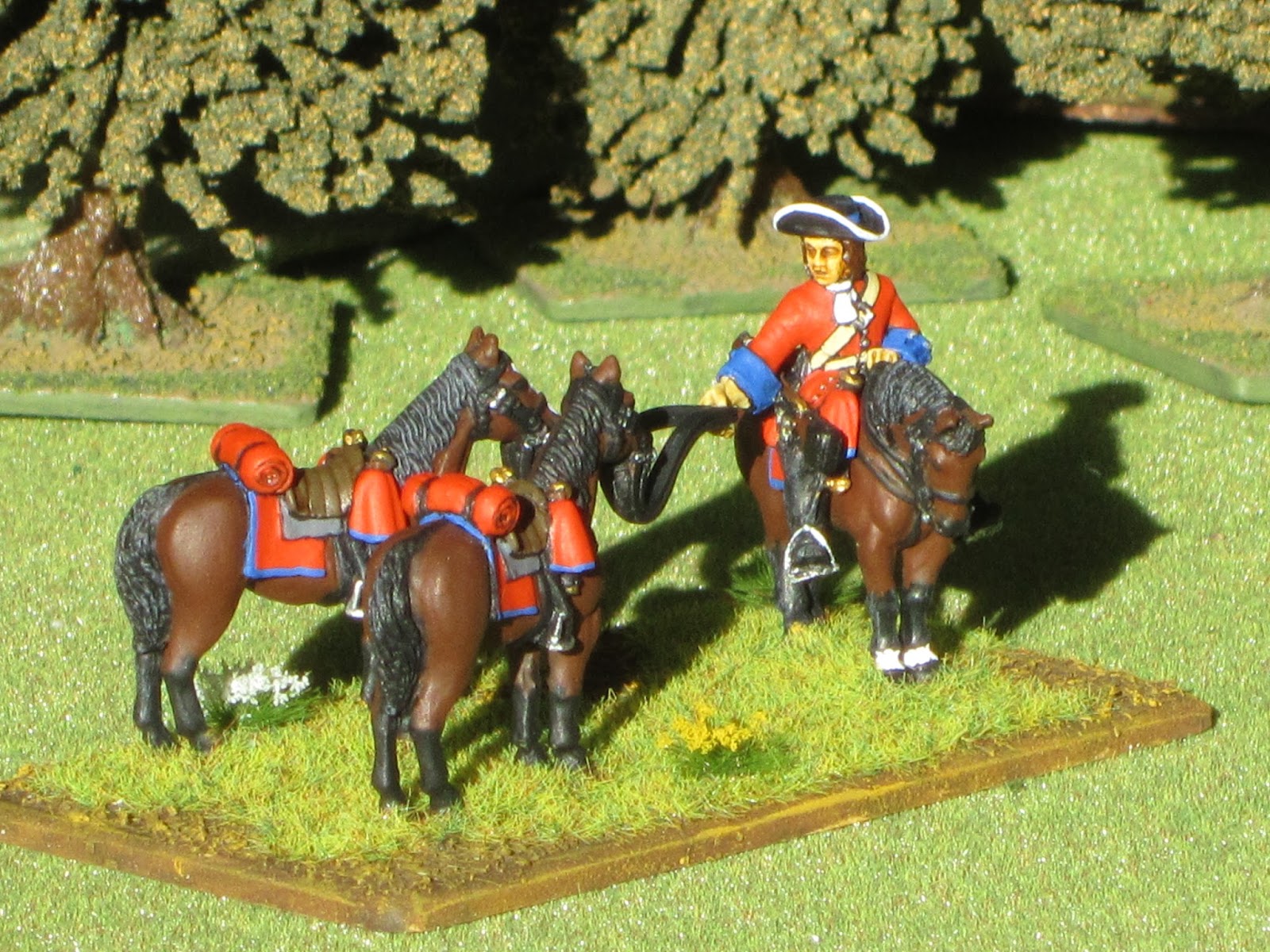
It took a bit longer than anticipated, but I've finally finished off the mounted stands for Lord Dongan's Jacobite dragoons. These complement the dismounted stands for the same regiment from an earlier dispatch. The figures are Front Rank 28mm and, as usual, the foliage is from Rodger Wood Wargaming Enterprises. The flag is from the Warfare Miniatures range. I'll now concentrate on painting up four regiments of foot over the next few months so that I'll have the basis of a playable Jacobite force for the Southern Strategists demo game at Conquest in Christchurch in early November. One of the other blokes from our group is also painting up some units that will bolster the Jacobite force, which takes a bit of pressure off me.  


The next unit due off the painting table is the AWI British Legion infantry in 28mm.

Until next time!  

Saturday, 16 January 2016

Napoleonic French Division/ Corps Commander

The last pieces of wargaming work I finished in 2015 consisted of a mounted Divisional/ Corps command stand and a couple of terrain pieces. I was short of a proper senior command stand for my 28mm French Peninsula army so I thought it wouldn't take me long to paint one up. How wrong I was. I had the Front Rank and Brigade Games figures undercoated for months before I got around to finishing them off. However, I'm happy with the final result which is loosely based on Soult and his ADCs. Apparently Marshal Soult had an ADC who wore a yellow coat that would have made him stand out on the battlefield. The terrain pieces consist of a scratch-built fenced field and a cemetery using headstones from 4Ground. I'm not totally happy with the look of the headstones which might need a bit more dry brushing in 'Stone wall grey' to get the desired look.
A French general and his staff observing a battle 

The yellow-coated ADC and the gemeral are from Front Rank, while the two ADCs to the right are from Brigade Games


A scratch-built fenced field intended for my AWI and ACW games


The new versatile cemetery using 4Ground headstones 

   
Until next time!

Thursday, 7 January 2016

Jacobite dragoons - Lord Dongan's regiment in Ireland 1690

As it is the last day of my summer holiday I thought I would use the time to update my blog. Following on with my project to build a Jacobite force to defend King James's realm in Ireland, the dismounted troops of Lord Dongan's Regiment of Dragoons was the last completed unit to emerge from my painting table in 2015. I'm not far off completing the mounted stands for this unit and hope to have them ready by next week. The figures are by Front Rank and the flag is from the 'Warfare' range as can be seen on the superb 'League of Augsburg' website. The foliage is once again supplied by Rodger Wood Wargaming Enterprises. The basing is to that suggested in the 'Beneath the Lily Banner' rule set, with only 5 figures per base for dismounted dragoons compared to 6 for infantry. The Southern Strategists are planning to put on a demo game of the Williamite War in Ireland at the annual Conquest convention here in Christchurch in October, so I still have plenty of painting to do to ensure the Jacobites have a strong force to deal to the Protestant usurper, William of Orange. Apologies for the poor image quality as I was lazy and just used my wife's 'point and shoot' camera which I'm still learning to use properly.


There are only 2 stands for this unit's firing line, taking into account troops needed as horse-holders in the rear 

The command stand


The horse-holder stand represents the troops required to remain in the rear with the horses 


The senior mounted officer is not part of the unit and will be used to command a brigade


These are two spare figures that I thought would come in handy for defending buildings  I intend to make for the project 
     Until next time!

Saturday, 5 December 2015

Trip to Wellington - Part 2

As promised, I've assembled more images of our family visit to the Great War Exhibition and Te Papa in Wellington. The Te Papa exhibition focuses on a number of over-sized models of individual New Zealanders who served at Gallipoli, as well as some dioramas and inter-active displays...truly fantastic! The Te Papa exhibition and the Great War Exhibition compliment each other and visitors should set aside a whole day if they want to take in both in one day.      
Lt. Herbert Westmacott of the Auckland Infantry Battalion who was wounded at Gallipoli on the day of the landing. This Weta Workshop model at Te Papa is so detailed you can even see the sweat on his face